
If you are shopping for a hot tub, or rethinking how you treat the water in the one you already own, the saltwater question comes up fast. Here is the short answer. Both systems sanitize with chlorine. A saltwater hot tub makes its own chlorine from salt dissolved in the water, so you add far less product by hand. Traditional care means you add sanitizer yourself on a schedule. The water is not fundamentally different. What changes is your weekly routine and the parts you eventually replace.
Both systems end up at chlorine
The phrase saltwater gets read as chlorine-free, and that is the first thing to clear up. A salt system holds a cell that passes a low electrical current through salted water and converts it into chlorine, continuously and in very small amounts. The sanitizer is the same. The delivery is what differs.
That steady trickle is why salt water tends to feel softer on skin and carries less of the sharp smell people associate with spas. You are avoiding the peaks and valleys that come from adding granules after a soak, waiting for them to work, then watching the level fall again before the next use.
What a week looks like on a salt system
You still test the water, usually once a week, and you still manage pH and alkalinity. Those do not go away on any system. What you stop doing is the regular manual dose. The cell handles routine sanitizing on its own, and you adjust its output rather than measuring product.
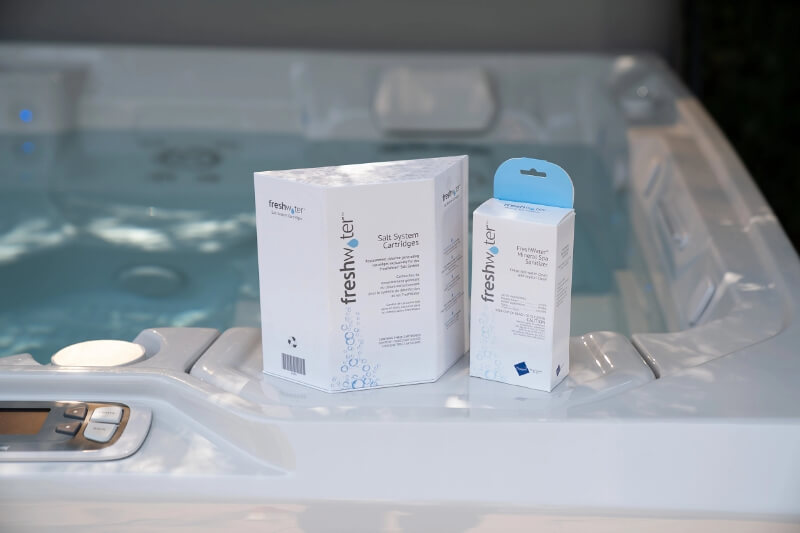
Salt gets topped up occasionally, since it leaves the water mainly through splash-out and refills rather than being consumed. The cell itself is a wear item. It runs for a stretch measured in months rather than weeks, then gets replaced on the schedule your system calls for. Filters still need rinsing, the cover still needs care, and heavy bather loads still call for a shock treatment.
What a week looks like with traditional chlorine or bromine
Traditional care is more hands-on and more responsive. You test more often, usually a couple of times a week, dose sanitizer after use or every few days, and shock on a regular cycle. In exchange you get direct control and very simple equipment. There is no cell to monitor or replace, and when the water goes off you can correct it immediately instead of waiting for a system to catch up.
The tradeoff shows up when use is uneven. A quiet week followed by a weekend with six people in the tub puts real swings on a manually dosed spa, and that is where owners most often fall behind.
Bakersfield water is hard, and that matters either way
Kern County fill water carries a high mineral load, and minerals are what drive scale. Scale builds on heaters, on jet faces, and on salt cells in particular, because the cell is where the chemistry is happening. On a salt system that means periodic cell cleaning is part of normal ownership here, not a sign something is wrong. On a traditional system it means staying on top of calcium hardness and pH so scale does not get a foothold.
This is the part most comparison articles skip, and it is the one that actually decides how a system behaves locally. Before you commit either way, it is worth bringing a water sample in for a free water analysis at our Bakersfield showroom so you know what you are starting from.
Which one suits which owner
Salt tends to fit people who soak often, want fewer weekly decisions, and do not mind a wear part on a service cycle. Traditional care tends to fit people who use the tub less predictably, like having direct control, or want the simplest possible equipment behind the panel.
Worth knowing: on many current spas this is not a one-time fork in the road. Several of the Hot Spring Spas models we carry pair their water care with smart water monitoring, which tracks conditions and tells you when something actually needs attention rather than leaving you to guess.
Do saltwater hot tubs still use chlorine?
Yes. A salt system generates chlorine from the salt in the water rather than removing chlorine from the equation. The difference is that it produces a small, continuous amount instead of you adding a larger dose by hand.
Is a saltwater hot tub less maintenance?
It is less frequent maintenance, not no maintenance. You test and balance less often and dose far less, but you still manage pH and alkalinity, clean filters, and replace the salt cell when its service life is up.
Can I convert an existing hot tub to salt water?
Sometimes, depending on the spa and the system. Compatibility varies by model and by manufacturer, and putting the wrong system on the wrong equipment can affect your warranty.
Does hard water cause problems with a salt system?
Hard water does not rule out a salt system, but it does mean scale management is part of the routine. Expect to clean the cell periodically and to keep an eye on calcium hardness, which is true of any heated water in this area.
See both in person before you decide
The easiest way to settle this is to look at how each system is actually operated, which takes about five minutes with a spa in front of you. Come see us at 4301 Yeager Way, Bakersfield, CA 93313, or call (661) 396-8827. We are open Monday through Friday from 10am to 6pm and Saturday from 10am to 5pm.