
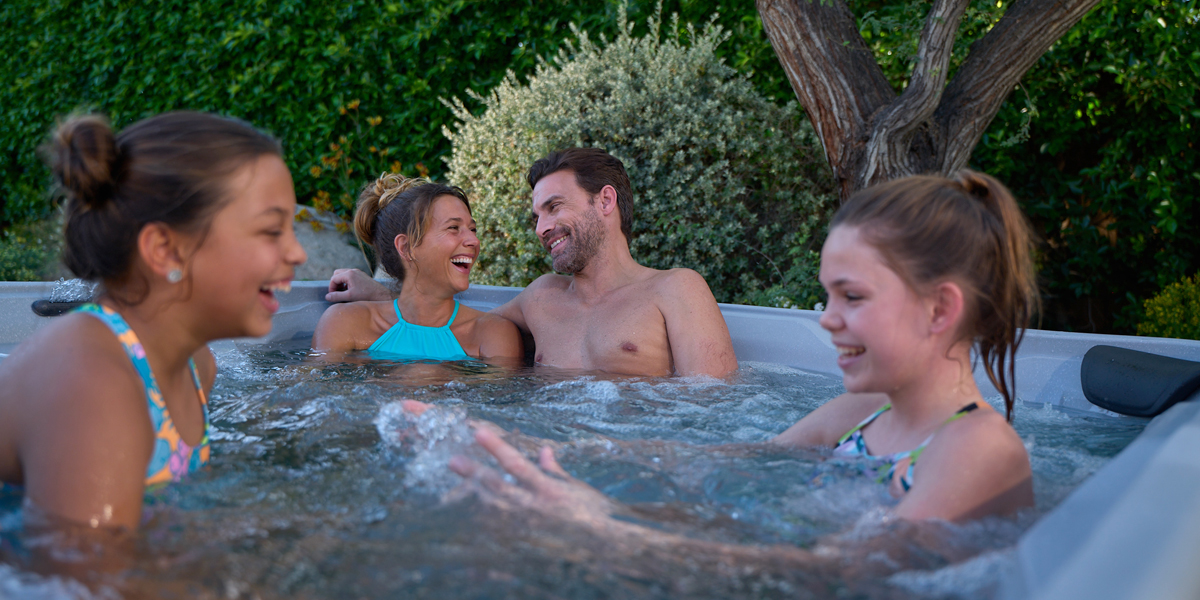
Every summer, someone walks into our showroom on Yeager Way, looks at a display spa sitting at 102 degrees, and asks the same question. Why would anyone climb into that when it is 106 outside?
It is a fair thing to wonder in Bakersfield. It also has a better answer than most people expect. Summer is one of the heaviest use seasons for hot tub owners in Kern County. The difference between an owner who loves their spa in July and one who covers it up until October usually comes down to three or four small adjustments made in June.
Summer is when a lot of local owners use their spa most
Bakersfield afternoons in July and August are not backyard weather. Evenings are a different story. Once the sun drops behind the fence and the air settles into the 80s, the patio finally becomes usable, and that is exactly when the spa gets busy.
Owners tell us the same things year after year. The kids treat it as the neighborhood pool from the minute school lets out. Adults use it after dark, when the yard is quiet and the water feels cooler than the concrete. Early risers get in before work, when it is still in the 70s. The spa stops being a winter product and becomes the reason people go outside at all.
Turn the temperature down, not the tub off
This is the single change that matters most, and most owners do not realize it is an option.
Finding a warm weather set point
Through the winter, most owners keep their water somewhere around 100 to 102 degrees. In the summer, many drop into the mid 90s, and some go lower than that. Water in the mid 90s still feels pleasant and buoyant after a long day, but it does not add heat to an already warm evening.
Work down in small steps rather than all at once. Drop two degrees, live with it for a few days, then decide whether to go lower. Every Hot Spring model has a minimum set point, so check your owner’s manual or ask us how low your specific spa will go.
Why you cannot turn a hot tub into a cold tub
There is a limit here worth understanding before you get frustrated. Jet pumps generate heat through friction as they run. Warm air transfers heat into the water through the shell and the surface. In a valley summer, the water is simply not going to sit far below the overnight low, no matter what the panel says.
If you want water in the 40s or 50s, that requires active refrigeration, which is what a cold plunge with a chiller is built to do. A lot of local homeowners end up running both, and use them together.
What summer actually costs to run
Insulation works in both directions
The full foam insulation and fitted cover that keep heat inside a spa in January also keep summer heat out. Hot Spring’s Energy Smart design captures heat from the pumps and equipment bay rather than wasting it, and a spa held at a lower summer set point has less work to do to stay there. Running costs generally go down in warm months, not up.
Shutting down for the season usually costs more than it saves
Draining a spa and walking away for three months sounds like the thrifty move. In this climate it rarely is. Seals and gaskets dry out. An empty shell bakes in direct sun. A full spa with the power off turns cloudy and green fast at these temperatures, which means a full drain, clean, refill, and rebalance in September, and sometimes a service call for a component that failed while sitting idle.
Holding the water at a lower set point and keeping it circulating is the cheaper and simpler path for most owners. If you are going out of town for a few weeks, talk to our service team before you shut anything down.
Shade, covers, and where the spa sits
Placement matters more here than it does in a mild climate. A spa on a west facing patio takes the worst of the afternoon sun, which fades the cabinet, cooks the cover, and pushes water temperature up on its own.
A pergola, a shade sail, or an awning solves most of it. Keeping the cover closed during the day helps just as much, both for temperature and for keeping valley dust out of the water. If lifting a heavy cover in the heat is the reason it stays open, an automated Covana cover is worth looking at, because it doubles as a shade structure when it is up.
Water care in a Bakersfield summer
Sanitizer burns off faster than you think
Three things gang up on your water in July. Direct UV breaks down sanitizer. Higher temperatures speed up everything chemically. And bather load goes way up, along with the sunscreen, lotion, and sweat that come with it.
Test more often than you do in the winter, at least a couple of times a week during heavy use. The FreshWater IQ system takes the guesswork out of it by monitoring the water and telling you what it needs.
Evaporation and our local water
Bakersfield tap water is hard, and evaporation makes that matter more. Every gallon that evaporates leaves its minerals behind, and every top off adds more. Over a hot summer that shows up as cloudiness, scale on the shell, and chemicals that stop behaving the way they should.
Bring us a water sample and we will run a free water analysis and tell you exactly what your water needs. There is no charge and you do not need to have bought your spa from us.
Come see one on a hot afternoon
The easiest way to settle the summer question is to stop by and feel what water in the mid 90s is actually like when it is triple digits outside. Our showroom is at 4301 Yeager Way in Bakersfield, and we are open Monday through Friday from 10am to 6pm and Saturday from 10am to 5pm.
Call us at 661-396-8827 with questions, or request pricing on the Hot Spring model you have your eye on.