
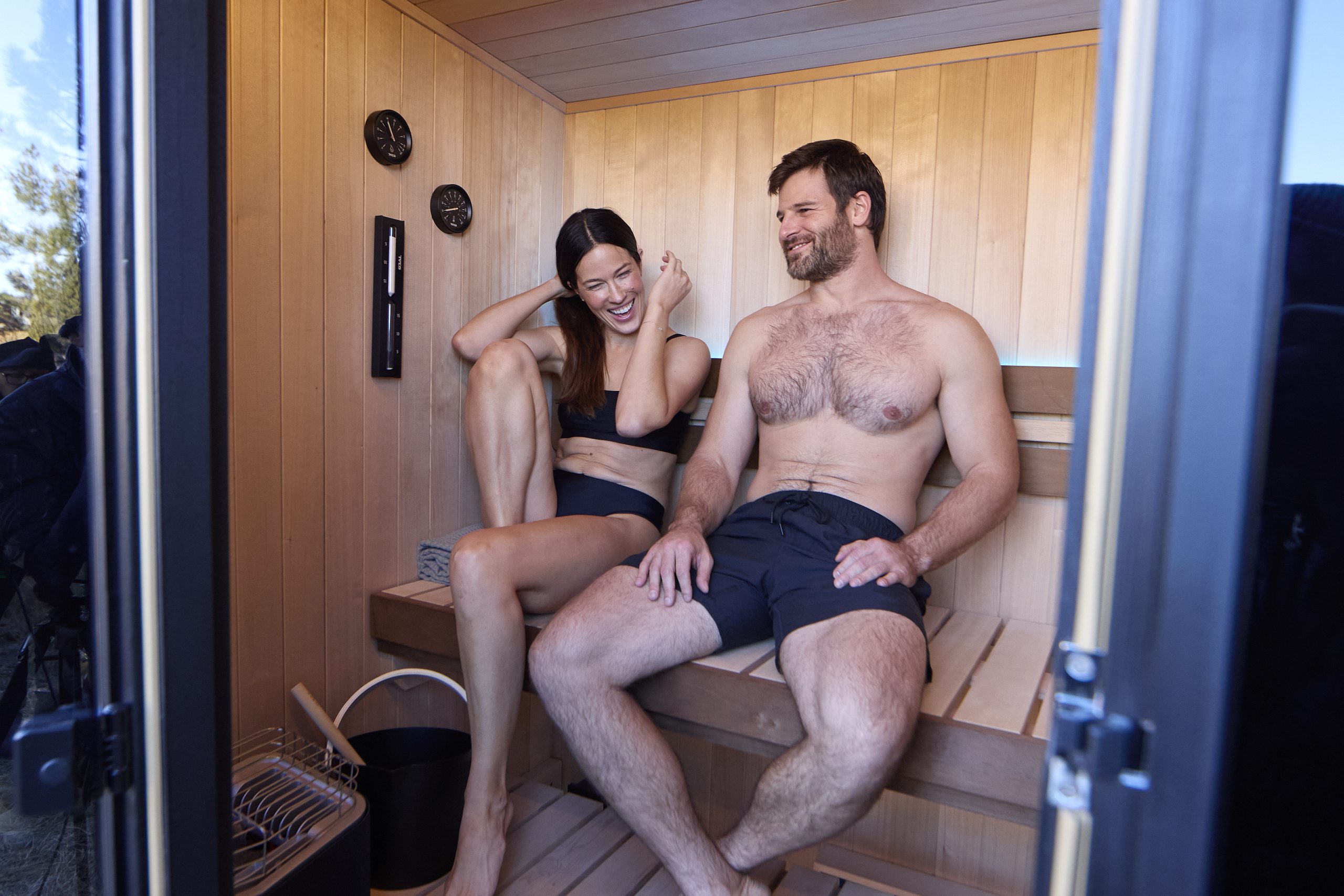
Home saunas have gone from a niche item to something we get asked about every week. The first question is almost always the same. Should I get a traditional sauna or an infrared one?
There is no universal right answer, but there is usually a right answer for you. It comes down to what you want a session to feel like, where the sauna is going to live, and what your home’s electrical situation can handle. Here is how to think it through.
How each one heats you
A traditional sauna heats the air. An electric heater brings the room itself up to temperature, and that hot air surrounds you. Pouring water over the heated stones sends up a burst of steam, called löyly, which raises the humidity and makes the heat feel more intense for a few minutes.
An infrared sauna heats you more directly. Emitters send out infrared energy that your body absorbs, so you warm up while the surrounding air stays considerably cooler than it would in a traditional room.
That single difference drives almost everything else about how the two feel to use.
Temperature, humidity, and what a session feels like
Traditional heat
Traditional saunas typically run between roughly 150 and 195 degrees, and you control the humidity yourself with the water ladle. It is an enveloping, unmistakable heat. Sessions tend to be shorter, and most people go in cycles: heat, cool down, repeat. If you have used a sauna at a gym, a club, or on a trip to Finland, this is the experience you are remembering.
Infrared heat
Infrared cabins usually operate in the range of about 110 to 140 degrees. The air is much gentler, so sessions often run longer, and people who find traditional heat overwhelming or hard to breathe in generally find infrared more manageable. You will still sweat, but the room never gets uncomfortably hot to sit in.
There is no water on stones with infrared, so no steam burst and no humidity control. If that ritual is the part you care about, that matters.
Install requirements most people do not expect
Electrical service
This is where projects stall, so check it early. Most electric sauna heaters for a traditional room need a dedicated 240 volt circuit sized to the heater, wired by a licensed electrician. Smaller infrared cabins are often designed to run on a standard household circuit, which is part of their appeal for indoor installs.
In some of the older neighborhoods around central and east Bakersfield, panel capacity is the real constraint. It is worth having an electrician look at your panel before you pick a model rather than after.
Ventilation and clearances
A traditional sauna needs proper air intake and exhaust to work correctly, along with specified clearances around the heater. An infrared cabin is more forgiving on both counts. Either way, the manufacturer’s clearances are not suggestions, and getting them right is part of what we help with during planning.
Indoor, garage, or outdoor placement in the valley
Where the sauna goes changes the calculation more here than it does in a mild climate.
Indoor installs, in a spare bathroom, a large closet, or a finished bonus room, are the most comfortable option year round. You are walking from a conditioned space into the sauna and back.
Garage installs are popular because the space is available, but be realistic about a Bakersfield garage. An uninsulated garage can sit well above 100 degrees on an August afternoon, which means there is nowhere pleasant to cool down between rounds, and that cool down is a real part of the experience. If the garage is the plan, insulation and some ventilation or cooling make a large difference.
Outdoor saunas work beautifully here from roughly October through April, and that stretch is honestly when most local owners use a sauna anyway. Once the tule fog settles in for the winter, a warm sauna in the backyard is a very easy sell.
Running cost and heat up time
A traditional heater draws more power and needs longer to bring the room up, commonly somewhere around 30 to 45 minutes depending on the heater and the room size. Infrared cabins draw less and are usable much sooner, often within 10 to 20 minutes.
For a frequent user, the practical difference is scheduling. If you want to decide on a whim and be in the sauna shortly after, infrared makes that easier. If your routine is planned, the traditional preheat is not much of an inconvenience.
Where Tylo fits
We carry Tylö saunas, a Swedish manufacturer that has been building sauna heaters and rooms for decades. The build quality, the heater engineering, and the parts support are the reasons we chose the line, and it matters that when something needs attention years from now, we can actually get the part.
We stock sizes from one person up through four person rooms, plus heaters and accessories. Rather than guessing from a spec sheet, come tell us how many people will use it, where it is going, and what your electrical looks like, and we will point you at the right configuration.
Sit in one before you decide
Heat is difficult to evaluate on a website. The best thing you can do is come sit in a heated sauna and see how the air feels to you, because reactions to traditional and infrared heat are genuinely personal.
Our showroom is at 4301 Yeager Way in Bakersfield, open Monday through Friday from 10am to 6pm and Saturday from 10am to 5pm. Call us at 661-396-8827 to ask about current availability, take a look at our sauna FAQ, or ask about financing if you want to spread the cost out.